ACHIEVEMENT TRACKER.

Time to Move the Strategic Needle.
Tracking strategic actions is essential. But it is not enough. You may be doing exactly what you said you would do. Your set of initiatives may be progressing on time, within budget and with the expected level of quality. Your teams may be busy, disciplined and committed. Your Strategic Action Tracker may even look reassuringly green. But this does not automatically mean that your strategy is working.
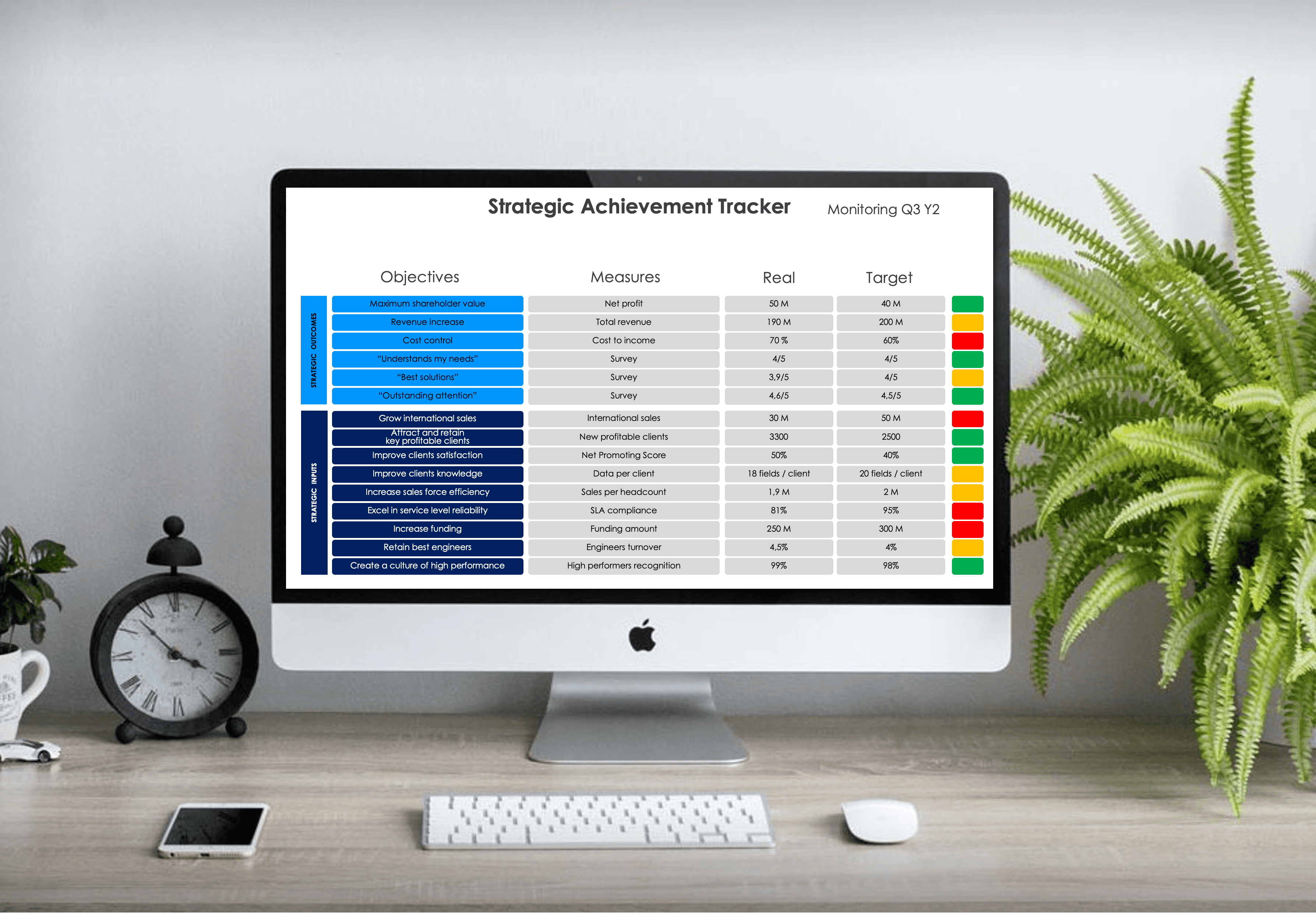
This is one of the great traps of strategy execution. Organisations often confuse busyness and project delivery with real business transformation. They assume that because the initiatives are being implemented, the strategic objectives are being achieved. Unfortunately, this is not always the case. This is why the Strategic Action Tracker must be complemented by a second tracking tool: the Strategic Achievement Tracker. The Strategic Action Tracker asks: Are we doing what we said we would do? The Strategic Achievement Tracker asks: Is what we are doing actually moving the strategic needle? The first tracks effort. The second tracks impact. Both are necessary. If you only track achievements, you may not understand why results are or are not improving. If you only track actions, you may become excellent at implementing initiatives that do not create enough strategic value. The goal is not just to become a great strategic doer. The goal is, on top of that, and more importantly, to become a great strategic achiever.
1. Track Strategy.
It sounds obvious, but it is often overlooked: the Strategic Achievement Tracker should focus on … strategy. Not everything that matters in the organisation belongs in this tracker. This is where many leadership teams struggle. Because once you start measuring performance, everything suddenly looks important: Instagram followers, absenteeism rates, legal process turnaround times, system uptime, governance compliance, salaries paid on time, employee engagement scores, customer complaints, audit findings, etc. All these measures may matter. Some of them may matter a lot. But important measures does not automatically mean strategic measures.
This distinction is critical. A measure can be important without being strategic. A measure can be necessary without belonging in the Strategic Achievement Tracker. A measure can be monitored elsewhere without taking up space in the organisation’s strategic cockpit. The Strategic Achievement Tracker must remain focused on one question: are we achieving our strategic objectives? In other words, are we steering the ship in the direction we deliberately chose? Are we making progress towards the transformation we committed to? Are we becoming the organisation we said we needed to become?
The good news is that you should not have to invent these measures from scratch. If you have built your AIM Stratpage properly, your strategic objectives are already clear. Your task is simply to ensure that each objective has a meaningful measure attached to it. Nothing more. Nothing less.
This does not mean those non-strategic measures should be ignored. It simply means they should be tracked in the right place. An organisation may need both an Operational Tracker and a Strategic Tracker: your Strategic Achievement Tracker.
The Operational Tracker monitors the health of the business. It helps leaders ensure that the day-to-day organisation is functioning properly, that core processes are under control and that performance remains within an acceptable range. It is primarily concerned with stability, reliability and operational discipline. It is the natural cockpit of the COO.
The Strategic Achievement Tracker plays a different role. It monitors the progress of the transformation. It focuses on the few measures that show whether the organisation is making meaningful progress against its strategic choices. It is concerned with movement, ambition and stretch. It is the natural cockpit of the CEO, the CSO and the team responsible for transforming the organisation.
Many organisations require both operational attention and strategic transformation. But they should definitely not be confused in the same tracker. The moment you start mixing both, you create confusion and you dilute focus.
2. Track Less.
Grace Hopper is often associated with the powerful idea that “one accurate measurement is worth a thousand expert opinions”. Whether in science, technology or strategy execution, the principle is the same: a good measure cuts through noise, opinion and endless debate. More measures do not create more clarity. In fact, they often create the opposite. More measures usually mean more reporting, more complexity, more meetings, more explanations and more opportunities for leaders to get lost in the data. The purpose of the Strategic Achievement Tracker is not to prove that everything is being measured and under control. It is to reveal whether the few things that matter most are improving.
Twenty plus years ago, when I worked for Harvard Professor Robert Kaplan and David Norton’s consulting firm, it was common to track several measures per strategic objective. Two, three, four or even five measures per objective could easily be justified. In theory, this created precision. In practice, it created a reporting monster. Imagine an organisation with twenty-five strategic objectives and multiple measures attached to each one. Very quickly, the leadership team can end up tracking one hundred or two hundred indicators. At that point, the organisation may have a lot of data, but very little strategic clarity.
This is the paradox of measurement: the more you measure, the harder it becomes to see what truly matters. My recommendation is therefore deliberately simple: choose one primary measure per strategic objective. Not because reality is simple, but because focus is powerful. A good strategy execution system should not drown leaders in data. It should help them see the truth faster.
3. Track Facts.
Look at the phrase printed on the American dollar bill: “In God We Trust.” Edwards Deming sharpened this idea for the world of management with a more demanding version: “In God we trust; all others must bring data.” That should be the spirit of the Strategic Achievement Tracker.
The goal is to reduce opinion, biases and personal interpretation as much as possible. Strategic performance conversations should not depend only on who speaks the loudest, who presents most confidently or who defends their area most cleverly. They should be grounded in evidence. This does not mean that every strategic measure will be perfectly objective. First because you can not remove completely subjectivity. The moment you put a target, it is somehow subjective. Second because strategy often deals with complex and partly intangible realities: culture, leadership, trust, customer perception, collaboration, employee commitment, brand reputation, to name a few. These things matter deeply, but they are not always easy to measure cleanly.
The challenge is not to avoid measuring them because they are difficult. The challenge is to measure them with enough rigour to make the conversation useful. A few isolated opinions can be misleading. Three unhappy customers may reveal an important issue, or they may simply represent three unhappy customers. Three hundred responses, or three thousand, can start to reveal a pattern. This is where the rule of large numbers becomes useful. If you must measure something subjective, do not rely too heavily on the most recent anecdote. Gather enough data to make the signals more reliable. The aim is not mathematical perfection. The aim is increased objectivity.
A good Strategic Achievement Tracker should therefore favour measures that are clear and as objective as possible. This matters because the quality of your measures shapes the quality of your decisions. Weak measures create weak conversations. Vague measures create vague accountability. Too many measures create confusion. Subjective measures create politics. Late measures create delayed reactions. But clear measures create focus. The Strategic Achievement Tracker is not there to decorate the strategy. It is there to measure whether the strategy is working. It is the place where the organisation asks the most important question in strategy execution:
Are we actually achieving our expected strategic transformation?

Join the 8% club
"Only 8% of leaders are good at both strategy definition and strategy execution" according to a HBR article. Which kind of leader are you?
Sign up for our newsletter and join the 8% club to unlock the secrets to excelling in both definition and execution of your strategy. Gain invaluable insights from case studies, proven tools, academic research, thought-provoking articles, networking opportunities, and much more …
* Both free and priceless at the same time
** We don’t share your personal information