ACT STRATPAGE.
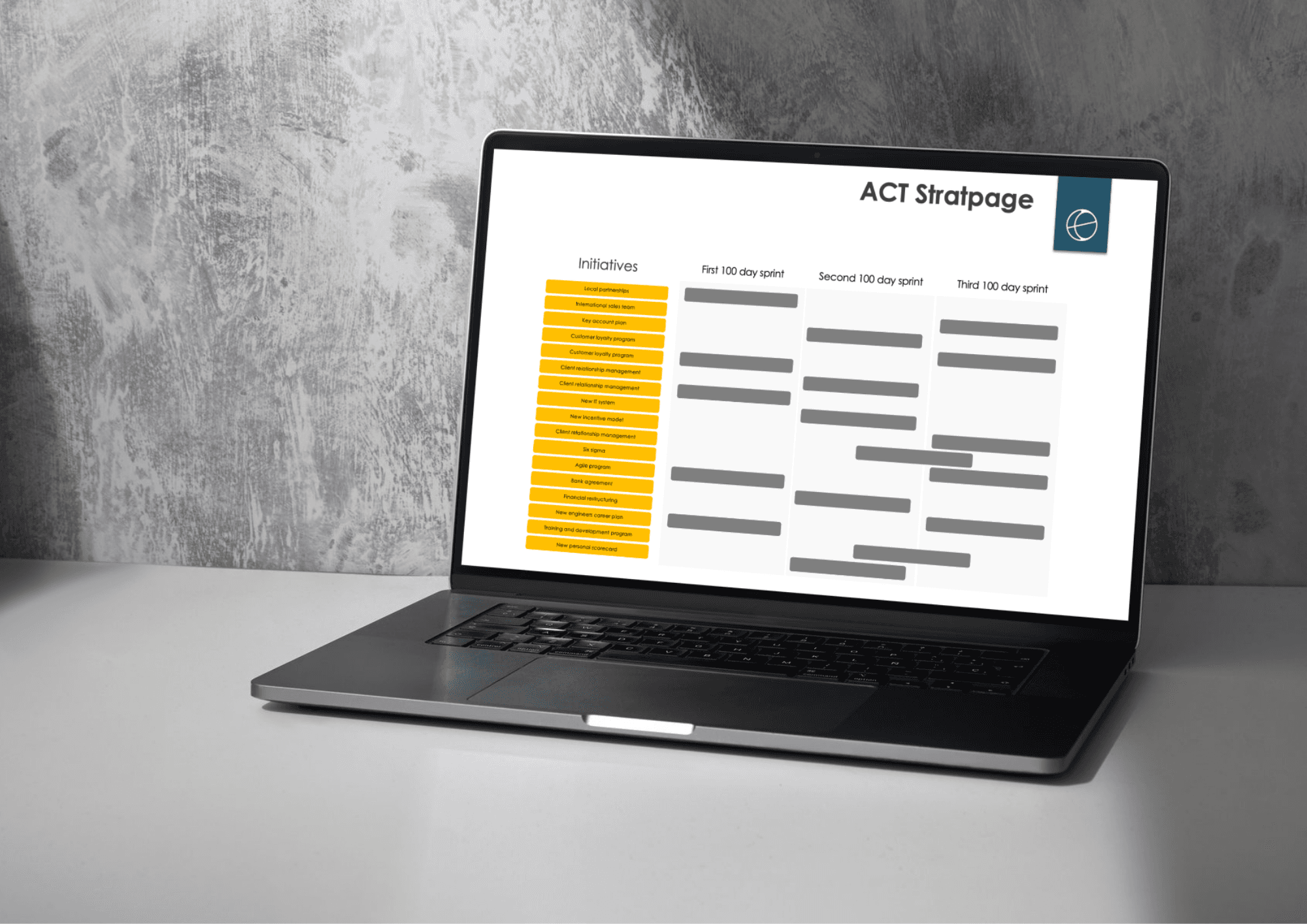
Your strategy transformational roadmap, summarised into one single page.
1. Strategic Impact:
Are you "Busy Being Busy"?
Initiative Rule 1: Obsess over impact.
If an initiative does not move the strategic needle, kill it! Too many organisations confuse busyness with impact. They launch projects, attend progress meetings, create long reports and pride themselves on working very hard, while creating very little strategic movement. The problem is not a lack of effort. In most organisations, people are already busy. Very busy. The problem is that too much of that energy is absorbed by initiatives that are operational, urgent, politically visible or simply familiar. But not truly strategic.
This is where the ACT Stratpage begins. Start by asking one brutal question: will this initiative / action genuinely move the needle on our strategic objectives? If the answer is no, it does not belong in your strategy execution agenda. This sounds obvious, but it is rarely practised with enough discipline. Many organisations build initiative portfolios by collecting everything that is already happening. Every project wants to be called "strategic". Every department wants its programme to appear on the roadmap. Every leader wants their priorities to be visible. The result is often a crowded list of activities that looks impressive, but does not create focus. A powerful strategy execution roadmap should not be a catalogue of everything the organisation is doing. It should be a clear (and often very hard) selection of the handful actions that will make the biggest strategic impact. This is why strategic impact must be the first filter.
Strategic Impact Matrix:
A useful way to apply this filter is to build the Strategic Impact Matrix. Start by listing your current and planned actions, projects, campaigns and programmes (everything that keeps you and your team busy). Then assess each initiative against two simple dimensions:
The first is strategic impact: How strongly will this initiative contribute to the strategic objectives on your AIM Stratpage?
The second is organisational complexity: How difficult will it be to execute in terms of time, budget, people, leadership effort, cross-functional collaboration and change required?
This exercise creates a powerful conversation. It forces leaders to separate operational noise from strategic action. It highlights initiatives that may be useful, but not transformational. It reveals projects that absorb huge amounts of energy without creating meaningful value. It also brings attention to the few initiatives that are perhaps harder to execute, but essential to deliver real strategic results.
Four types of initiatives will stand out:
Some initiatives will be high impact and relatively easy to implement. These are the “no brainers” that should be accelerated quickly. Spoiler: you won't find a lot.
On the other side some initiatives will clearly be low strategic impact and highly complex. These are the dangerous ones, the "no ways". They create effort without movement. They should be stopped immediately.
Some initiatives will be high impact but (relatively, or very) complex. They are the 20% of action that drive 80% of the impact. They should be your "strategic obsession"! They require serious attention, resources and leadership commitment, but they are the ones most likely to shift the organisation towards its ambition.
Some initiatives will be, on the contrary, low impact and low complexity. They are easy or easier, employees know them, maybe like them. It's the comfort zone. But they are not part of the impact zone (the right side of the graph). Not only they are strategically irrelevant, they are also a strategic distraction, because all the effort, money, and resources they attract represents less effort, money, and resources for the real strategic initiatives. They are your strategic enemy!
Henry David Thoreau said it well: “It is not enough to be busy. So are the ants. The question is, what are we busy about?” That question should sit at the heart of every strategy execution conversation. Are we busy protecting the past, or building the future? Are we busy responding to noise, or delivering the strategy? Are we busy producing busyness, or driving real business impact?
In strategy execution, effort is not the goal. Impact is.
Stop the "busy being busy". Obsess over impact.


2. Strategic Resources:
You Can Do Anything, But You Cannot Do Everything.
Initiative Rule 2: Resource the few, or dilute the many.
A strategic initiative without sufficient resources is not a strategy. It is a DREAM 😴
Once the right strategic initiatives have been selected, they need to be properly EQUIPPED. This is where many organisations fail. Not because their initiatives are wrong, but because they launch too many of them with too little financial or human capacity.
The first prioritisation cut is about strategic impact. It removes initiatives that are "out of scope" because they do not move the strategic needle.
The second prioritisation cut is about strategic resources. It parks initiatives that are "out of reach" because the organisation does not currently have the capacity to execute them properly. This second distinction matters. An initiative can be strategically relevant and still be unrealistic. It may have a strong impact on the strategic objectives, a compelling business case and enthusiastic leadership support. But if it does not have enough budget, enough people, enough time or enough executive attention, it will struggle to deliver.
Many strategy execution failures are born at this exact moment. Leaders approve too many initiatives at once. They underestimate the level of work required. They assume already busy people will somehow find the time. They spread budget too thinly. Then, a few months later, they wonder why progress is slow. The uncomfortable truth is that under-resourced initiatives rarely fail dramatically. They fail quietly. They remain open. They appear in reports. They move from one meeting to the next. They are always “in progress”, but never really breaking through.
This is why the ACT Stratpage must be more than a list of good ideas. It must become a fully resourced strategic transformation roadmap. To achieve this, each initiative needs to be defined with enough clarity to understand what it will really take to execute. The scope must be clear. What is the initiative meant to achieve? The work plan must be realistic. What are the key phases, milestones, deliverables, start dates and end dates? The team must be visible. Who will lead the initiative, who will contribute, and how much leadership attention will be required? The budget must also be honest. What level of "strategic expenditure" is needed to give your initiatives a real chance of success? This is where ambition meets reality.
Every organisation would love to drive faster, further and bolder. Everyone wants the Ferrari version of their strategy. But sometimes the available budget, team and capacity only allow for a Toyota. That is not a failure. A Toyota can still take you to the destination. The real danger is pretending you are driving a Ferrari when you have only funded a bicycle.
Strategy execution requires hard and honest choices. You can do anything. But you cannot do everything. This principle is simple, BUT difficult. It requires leaders to accept that prioritisation is not only about deciding what matters. It is also about deciding what must wait.
Some initiatives should be launched immediately because they are high impact and within reach. They deserve the best resources, the strongest leadership support and the fastest start. Some initiatives should be parked because they are valuable, but not yet affordable. They may return to the roadmap later, once capacity improves or other initiatives have been completed. Some initiatives should be redesigned because their current version is too ambitious for the resources available. The Ferrari initiative may need to become a Toyota initiative, still useful, still strategic, but more realistic. And some initiatives should be stopped because they compete for resources without justifying their place in the strategic roadmap.
This is the second discipline of the ACT Stratpage: resource the few, or dilute the many.
A strategy does not fail only because of poor thinking. It also fails because too many organisations pretend that people, money and leadership attention are unlimited. The ACT Stratpage forces a better conversation. It asks leaders to match ambition with capacity. It makes resource allocation visible. It protects the most important initiatives from being starved by too many competing priorities.
Because great strategies do not need more promises. They need fewer, better, properly resourced initiatives.


3. Strategic Action:
Time to Turn Your Plan into Motion.
Initiative Rule 3: Shift from presentation mode to implementation mode.
The ACT Stratpage is not the end of the strategy process. It is just the beginning of focused strategic action.
A plan does not create impact because it is approved. It does not create impact because it is presented beautifully. It does not create impact because it appears on a slide, a wall, a dashboard or a one-page roadmap. A strategy creates impact when people start moving. Too many organisations treat the strategy presentation as the finish line. The leadership team works hard to define the ambition, clarify the objectives, select the initiatives and build the roadmap. The final document is polished. The slides look great. The session goes well. People nod. There is energy in the room.
Then Monday arrives: Emails return. Meetings restart. Operational fires take over. Urgent issues dominate the calendar. The beautiful plan slowly moves from centre stage to background noise. This is why the third discipline of the ACT Stratpage is strategic ACTION. Once the initiatives have been selected and resourced, the organisation must shift from presentation mode to implementation mode. The question is no longer “What is our strategy?” The question becomes “What are we doing today, this week and this month to make the strategy happen?”
This shift sounds simple, but it requires discipline:
First, leaders need to protect strategic initiatives from operational distractions. The day-to-day busyness will always be loud. Customers need attention. Problems need solving. Reports need writing. Meetings need attending. None of this disappears. But if strategic initiatives only receive leftover time, they will never create meaningful impact. Strategy execution needs protected attention. The most important initiatives must appear in leadership routines, management conversations and performance reviews. They must be discussed not as side projects, but as the core work required to move the organisation forward.
Second, the organisation needs to move from strategic thinking to strategic doing. Thinking is essential during strategy definition. You need to clarify choices, test assumptions and sharpen the plan. But once the plan is clear enough, more thinking cannot become an excuse for delayed action. There is a time to sharpen the axe. Then there is a time to chop. The ACT Stratpage helps make this transition visible. It turns ambition into initiatives. It turns initiatives into ownership. It turns ownership into milestones. It turns milestones into movement.
Third, leaders need to build execution stamina. Strategy execution is not a short burst of enthusiasm after a workshop. It is a sustained rhythm of action, follow-up, decision-making and adjustment. Most organisations do not fail because they never start. They fail because they do not keep going with enough consistency. The first few weeks after a strategy session are usually energised. The real test comes later, when the work becomes difficult, trade-offs appear, people get tired and progress becomes uneven. This is when strategic stamina matters. Execution requires repetition. It requires weekly and monthly discipline. It requires asking the same uncomfortable questions again and again. Are we progressing? What is stuck? What decision is needed? What resource is missing? What must be stopped, accelerated or changed?
Finally, leaders need to execute with agility. Turning the plan into motion does not mean blindly following the plan regardless of reality. Markets move. Customers shift. Competitors react. Technology changes. People leave. Budgets tighten. New opportunities appear. The roadmap matters, but the movement matters more. That means leaders must keep the strategic direction stable while being willing to adapt the initiatives. If an initiative is not delivering the expected impact, fix it or stop it. If a new opportunity supports the strategic objectives better, consider it. If the environment changes, adjust the route without losing sight of the destination.
Strategy must become conversations. The conversations must become decisions. The decisions must become actions. The actions must become impact.
Because strategy does not live in the presentation. It lives in the movement.
Turn the plan into motion.

Join the 8% club
"Only 8% of leaders are good at both strategy definition and strategy execution" according to a HBR article. Which kind of leader are you?
Sign up for our newsletter and join the 8% club to unlock the secrets to excelling in both definition and execution of your strategy. Gain invaluable insights from case studies, proven tools, academic research, thought-provoking articles, networking opportunities, and much more …
* Both free and priceless at the same time
** We don’t share your personal information