AIM STRATPAGE.
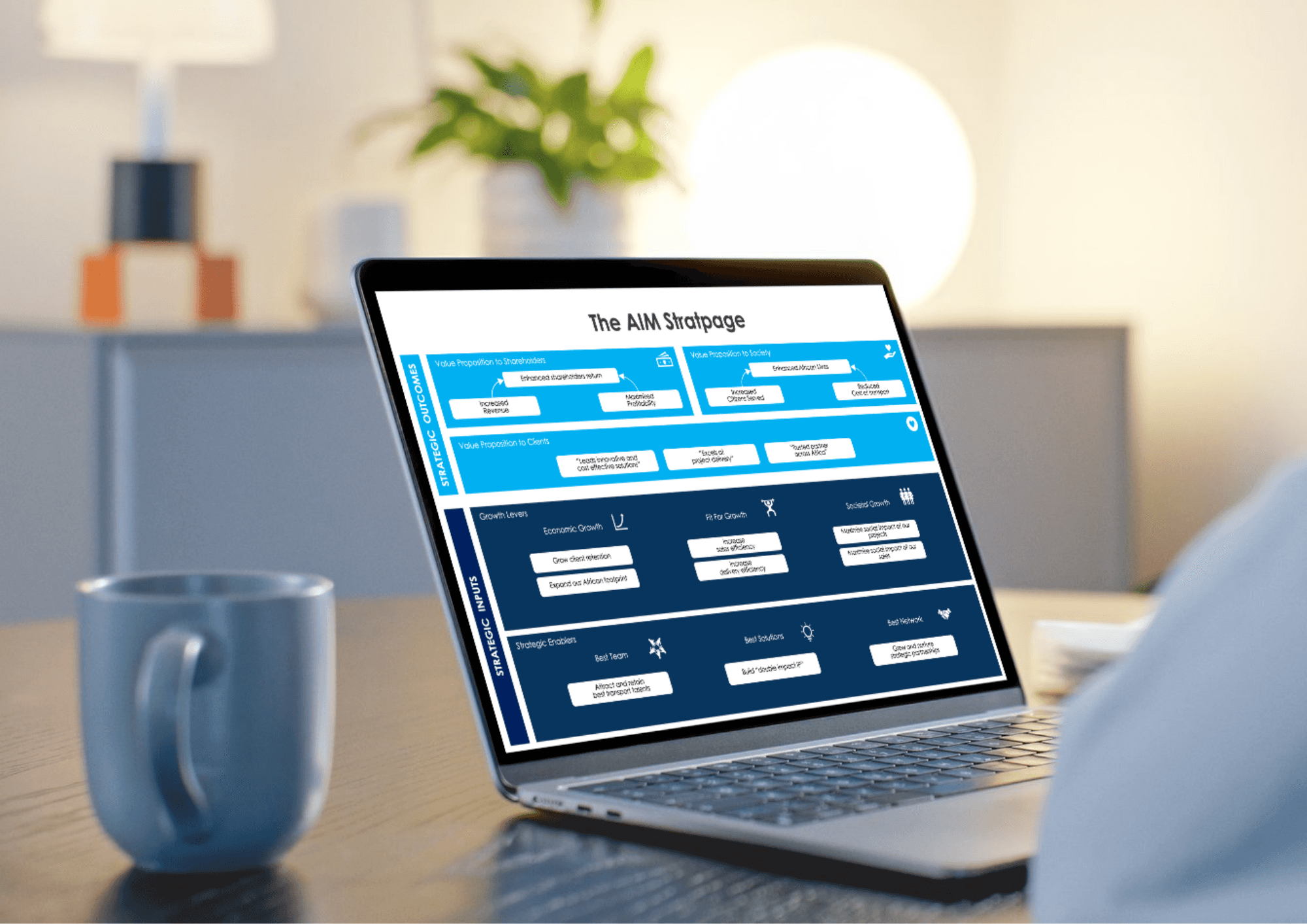
All your strategic objectives, summarised into one single page.
1. Summarise.
THE ESPRESSO
Many organisations end up with an extensive strategy. They produce lengthy documents that attempt to cover every possible goal, aspiration, risk, impact, theme and assumption. While this approach is well-intentioned, and often the result of thorough analysis, it frequently leads to a familiar outcome: the dreaded 500-page strategy document. You need to drastically summarise all this into a digestible, clear and appealing elixir.
The first school of thought tries to present a “clear” strategic direction that resembles a thick and dense collection of objectives, buzzwords, and loosely connected ideas. Some objectives overlap, others contradict each other, and many are expressed in vague or fashionable terminology. Despite the effort invested, the result often lacks clarity. Instead of offering clarity about what we are trying to achieve, it creates confusion. Everybody is lost.
At the opposite end of the spectrum, some leaders react to this complexity by pushing for extreme simplification. Strategy is reduced to a single word or a broad ambition such as “more”, “growth” or “transformation.” While appealing in its simplicity, this approach quickly reveals its limits. Without specificity, such statements provide little guidance. They fail to indicate what should be prioritised, what should change, or how success will be achieved. Everybody which to have a bit “more”.
The challenge, therefore, is not to choose between accuracy and simplicity, but to reconcile the two. Strategy must be both well-structured and crystal-clear. It must capture the richness of the thinking while remaining understandable and articulated.
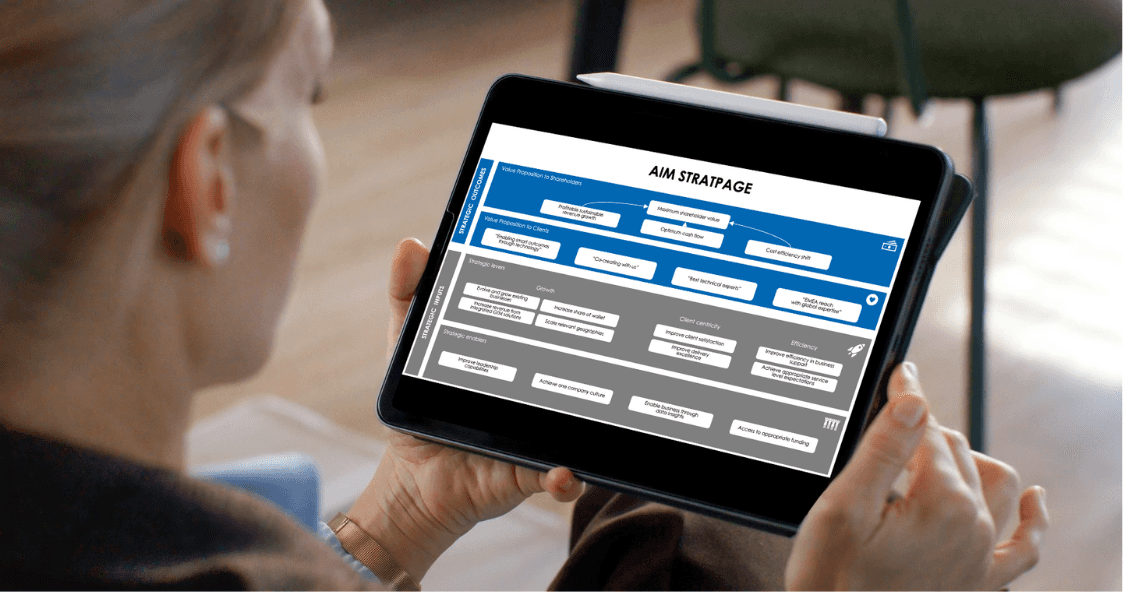
This is precisely the role of the AIM Stratpage. The logic is simple: strategy should be like an espresso: distilled to its essence, concentrated in its impact. This does not mean reducing strategy to a slogan. It means distilling it. The AIM Stratpage captures, in one page, the essence of the strategic direction. The coffee analogy is deliberate. A well-brewed espresso is neither diluted nor overwhelming. Too long, and it loses its intensity like an americano. Too short, and it becomes difficult to appreciate and bitter like a ristretto. The same applies to strategy. If it expands beyond a single page, it risks becoming diluted and losing focus. If it is overly compressed into vague statements, it becomes unusable.
Contrary to what one might expect, producing a one-page strategy is not easier than producing a long document. As Mark Twain famously observed “I’ve written you a long letter because I didn’t have time to write you a short one.” Writing something short takes much more time than writing something long. The same is true for strategy. The clear and structured AIM Stratpage is the result of effort and time, not of simplification and shortcuts.
This discipline allows focus. By limiting the space available, the AIM Stratpage forces leaders to identify the few strategic objectives that truly matter. It encourages a shift away from exhaustive lists toward a clear prioritisation of what will drive the organisation forward. In doing so, it separates strategy from operations and removes the noise of day-to-day activities, keeping attention on transformation.
Perhaps most importantly, it forces leaders to make trade-offs, it requires making tough choices, resolving ambiguities, and ignoring urgent matters, important issues, day-to-day thinking, operational challenges: it’s a ruthless elimination of all the non-essentials. Every strategic objective included on the page occupies valuable space. Including one means excluding another. It reinforces a fundamental principle of strategy: choosing what not to do is as important as choosing what to do. By making these choices explicit, the AIM Stratpage helps organisations move from intention to commitment.
It also facilitates alignment. Reaching consensus on a complex, multi-page document is difficult, if not impossible. Different stakeholders interpret it differently and emphasise different elements. A single page, however, creates a shared reference point. It becomes possible to challenge, refine, and ultimately agree on a common direction. The AIM Stratpage turns strategy into something that can be collectively understood and owned.
Once completed, the AIM Stratpage becomes the anchor of the strategy execution system. It is not just a document. It is a way of thinking. Like a well-prepared espresso, it captures the essence of something much larger, in a form that is both concentrated and effective.

2. Preempt.
ESCAPE THE ORDINARY
One of the most common mistakes in strategy work is also one of the most dangerous: leaders fill their AIM Stratpage with objectives that sound important, serious, and relevant, but are not truly strategic. They are simply a dressed-up version of operational management.
This is where discipline matters. The AIM Stratpage is not designed to capture everything the organisation needs to run well. It is not a summary of business as usual. It is not a list of urgent issues. It is not a reaction to the latest fire. It is not a polished description of the current business model. Its role is far more demanding than that. It is meant to define the few critical objectives that will shape the business of tomorrow.
If your objectives are too close to day-to-day operations, you are missing the point. If they are driven mainly by urgency, you are missing the point. If they are reactive, defensive, or merely descriptive of the current state of the business, you are missing the point. Strategic objectives are not there to describe the machine. They are there to transform it.
This distinction is fundamental. Operational management is about running the current business effectively. It focuses on delivery, control, efficiency, compliance, service levels, budgets, processes, and short-term problem-solving. All of these matter. Any serious executive knows that. But they do not belong, at least not in their raw form, on the AIM Stratpage. If they dominate the page, the strategy is already in trouble.
A useful test is to ask a brutally simple question: if we achieve this objective, will it merely help us run today’s business better, or will it meaningfully strengthen tomorrow’s business? The former may be important, but it remains operational. The latter is strategic. Strategy must elevate the conversation above the ordinary. It must pull the organisation out of administration and into transformation.
This is why strategic objectives need altitude. They must rise above the noise of daily execution and the pressure of immediate demands. They should not be written to satisfy this quarter’s panic, nor to reassure the leadership team that every pressing issue has been acknowledged. They should define the future shape of the organisation. They should express where the company is trying to go, what it is trying to become, and what capabilities, positions, and advantages it intends to build.
That is why the AIM stage requires leaders to stop and think hard. Before moving any further, before selecting initiatives, before allocating resources, before building trackers and dashboards, they must ensure that the strategic objectives are genuinely strategic. If they get this wrong, everything that follows will be compromised. The wrong objectives will produce the wrong initiatives, the wrong priorities, and eventually the wrong results. A weak AIM Stratpage cannot be saved by brilliant execution. It will only allow the organisation to execute the wrong things more efficiently.
This is where many leadership teams struggle. Operational issues are visible, concrete, and immediate. Strategic objectives are harder. They require stepping back. They require abstraction without vagueness, ambition without fantasy, and clarity without operational detail. They require leaders to elevate the discussion beyond what the business is doing today and focus on what it must become tomorrow.
In practice, this means excluding from the AIM Stratpage the large blocks of operational management that naturally occupy executive attention. Revenue reporting, budget control, cost containment, service delivery, process efficiency, compliance, routine customer issues, performance reviews, system uptime, staffing gaps, and monthly firefighting all matter enormously. But unless they are connected to a genuine transformation of the business model, market position, value proposition, capability base, or long-term competitiveness, they should remain in the domain of operational management. They belong in the engine room, not in the strategic cockpit.
A strategy document should never become a dumping ground for unresolved management concerns. That temptation is understandable. Executives carry real pressure, and it is often comforting to place urgent issues on the strategy page, as if doing so elevates them. It does not. It simply pollutes the strategy. The AIM Stratpage must remain a high-altitude document. It must be selective, disciplined, and future-oriented.
A good way to think about it is this: operational objectives help the business perform. Strategic objectives help the business evolve. Operational objectives protect and optimise the current model. Strategic objectives challenge, reshape, and extend it. Operational objectives keep the machine running. Strategic objectives define what the machine must become.
This does not mean strategy should ignore operational reality. Quite the opposite. Strong strategy is grounded in the realities of the current business. But it must not be imprisoned by them. Strategy should emerge from reality, not be reduced to it.
So stop here and pressure-test your objectives. Read each one carefully and ask yourself: is this truly shaping the future of the business, or is it simply managing the present more neatly? Is it transformative, or merely important? Is it defining tomorrow, or describing today? These are not semantic questions. They are strategic ones.
The AIM Stratpage only works when it escapes the ordinary. It must elevate the conversation, sharpen the ambition, and define the business of tomorrow. That is the standard. And that is why this step will make or break everything that follows.
If your AIM Stratpage reads like an executive committee agenda, it is not strategic enough. The AIM Stratpage is not there to manage today’s problems. It is there to build tomorrow’s advantage. Lastly, do not confuse importance with strategy. Many things are important. Very few are truly strategic.
THE ICEBERG
Imagine your AIM Stratpage as an iceberg. What sits above the surface is what everyone sees. What sits below is what actually makes it work. Strategy follows the same logic:
ABOVE | The strategic outcomes
The visible part of the iceberg represents your strategic outcomes. These are the results your organisation aims to deliver, the outcomes of your strategy. They reflect the value you create for the outside world: financial performance for your shareholders, differentiated value for your clients, and, increasingly and rightly so, a possible broader contribution to key stakeholders or to Society as a whole. These outcomes define success. They are what shareholders or stakeholders see, measure, and ultimately judge.
But they are only the consequence of something deeper.
_ _ _ _ _ _
BELOW | The strategic inputs
Beneath the waterline lies the engine of your strategy. This is where you define the inputs that will produce those outcomes. Two layers matter here.
The first layer is made of your strategic levers. These are the critical transformational engines your organisation must focus on. They answer a simple but demanding question: what must we change, build, or strengthen to achieve our desired outcomes? This is where ambition becomes concrete. Each lever represents a deliberate choice about where to focus effort and energy. And this is where the cause-and-effect logic starts to take shape. If these levers are delivered, they create the conditions for the outcomes to happen.
Below these levers sit the strategic enablers. These are the core capabilities that make everything possible. Talent, technology, systems, culture, partnerships, organisational structure, etc. They may appear further down on the page, but they are absolutely foundational. Without them, the levers cannot be executed. And without the levers, the outcomes remain vague aspirations.
This is why the AIM Stratpage should not be read from top to bottom as a hierarchy of importance. What sits at the top is not more critical. It is simply more visible. The real work happens below the surface, where the inputs are defined and aligned.
A strong strategy makes this chain explicit. It connects enablers to levers, and levers to outcomes. It shows how value will be created, not just what value is expected. That’s the value of your AIM Stratpage. It is not a random list of ambitions. It is a powerful system of cause and effect.
THE ANTICIPATED MANAGEMENT
The strength of the AIM Stratpage lies in its logic. It is not a static document. It is a dynamic system built on cause and effect. What you define as inputs today will shape the outputs of tomorrow.
This is where discipline becomes critical. Too often, leaders become obsessed with outcomes. Revenue, market share, valuation, impact. These matter, of course. But they are, by nature, partially out of reach. They depend on factors you do not fully control: market conditions, competitor moves, regulatory changes, or broader economic shifts.
The AIM Stratpage forces a different posture. It brings the focus back to what you can influence directly: the inputs. The strategic levers you choose to activate. The capabilities you decide to build. The priorities you commit to. This is where execution lives.
A strong strategy does not try to control everything. It concentrates effort where it can make a difference. It accepts that outcomes will follow, but only if the inputs are consistently delivered.
This also requires resisting a common temptation: reacting too quickly to external noise. A competitor makes a move. A new trend emerges. Market conditions shift. The instinct is often to revisit the strategy, to adjust direction, to rethink priorities.
But strategy cannot change every quarter. Once the AIM Stratpage is defined, it should provide stability. It should anchor the organisation. It should create enough clarity and conviction to move forward, even in the presence of uncertainty. This does not mean ignoring the outside world. It means separating strategic direction from operational reaction.
There should be a place, and a time, to challenge the strategy. A strategic intelligence capability to monitor key signals. A structured moment, typically once a year, to revisit assumptions, test relevance, and adjust if needed.
But outside of these moments, execution should not be constantly disrupted. Now is the time to focus. Focus on the inputs. Focus on what you can control, or at least strongly influence. Focus on delivering the levers you have chosen. Because if the inputs are right, and consistently executed, the outputs will follow. Be obsessed with them.

3. Intend.
THE STORY
If the AIM Stratpage were only a structuring tool, it would already be useful. But its real power lies elsewhere. It is a storytelling tool. A well-crafted AIM Stratpage does more than organise objectives. It reveals intent. It makes explicit the choices leadership has made, the direction it has chosen, and the future it is trying to build. In one page, it tells a coherent story of where the organisation is going and how it plans to get there.
This is why it is such a powerful alignment mechanism. Strategy often fails not because it is wrong, but because it is not understood. Different teams interpret it differently. Priorities get diluted. Execution drifts. The AIM Stratpage removes that ambiguity. It provides a shared reference point that everyone, from the executive team to the front line, can understand and align with.
In that sense, it is much more than a management tool. It is a communication and engagement tool. It allows leaders to explain the strategy clearly, to create buy-in, and to build commitment across the organisation and beyond, with partners, shareholders, and stakeholders.
No one size fits all. The AIM Stratpage adapts. It adjusts to the nature of the organisation, to its strategic context, and to the ambition of its leaders. It can express different strategic postures and make them visible.
For instance, it can reveal where the organisation chooses to play on the spectrum between shareholder value and broader stakeholder impact. Some strategies will emphasise financial performance and capital efficiency. Others will deliberately place more weight on social contribution, environmental impact, or long-term sustainability. Both are valid. What matters is that the intent is clear.
It can also make visible another fundamental tension: the balance between exploitation and exploration. Every leader, whether consciously or not, operates across these two roles. On one side, the focus is on optimising the current business model, improving efficiency, and extracting value from existing activities. On the other, the focus shifts to building new capabilities, exploring new markets, and creating the next engine of growth. This is where the tool becomes deeply strategic. It does not just describe the direction. It exposes the intent behind it. No confusion. Nowhere to hide.
The AIM Stratpage is a leadership statement. It translates strategic intent into a form that is both concise and powerful. It captures not only what the organisation aims to achieve, but also how it chooses to think and to prioritise. Used well, it becomes a guide. A way to align decisions, behaviours, and energy toward a common future. Because strategy is not only about defining where to go. It is about making sure everyone moves in the same direction.

Join the 8% club
"Only 8% of leaders are good at both strategy definition and strategy execution" according to a HBR article. Which kind of leader are you?
Sign up for our newsletter and join the 8% club to unlock the secrets to excelling in both definition and execution of your strategy. Gain invaluable insights from case studies, proven tools, academic research, thought-provoking articles, networking opportunities, and much more …
* Both free and priceless at the same time
** We don’t share your personal information