
One of the most common mistakes in strategy work is also one of the most dangerous: leaders fill their AIM Stratpage with objectives that sound important, serious, and relevant, but are not truly strategic. They are simply a dressed-up version of operational management.
This is where discipline matters. The AIM Stratpage is not designed to capture everything the organisation needs to run well. It is not a summary of business as usual. It is not a list of urgent issues. It is not a reaction to the latest fire. It is not a polished description of the current business model. Its role is far more demanding than that. It is meant to define the few critical objectives that will shape the business of tomorrow.
If your objectives are too close to day-to-day operations, or if they are driven mainly by urgency, you are missing the point. If they are reactive, defensive, or merely descriptive of the current state of the business, you are missing the point. Strategic objectives are not there to describe the machine. They are there to transform it.
This distinction is fundamental. Operational management is about running the current business effectively. It focuses on delivery, control, efficiency, compliance, service levels, budgets, processes, and short-term problem-solving. All of these matter. Any serious executive knows that. But they do not belong, at least not in their raw form, on the AIM Stratpage. If they dominate the page, the strategy is already in trouble.
A useful test is to ask a brutally simple question: if we achieve this objective, will it merely help us run today’s business better, or will it meaningfully strengthen or transforming tomorrow’s business? The former may be important, but it remains operational. The latter is strategic. Strategy must elevate the conversation above the ordinary. It must pull the organisation out of administration and into transformation.
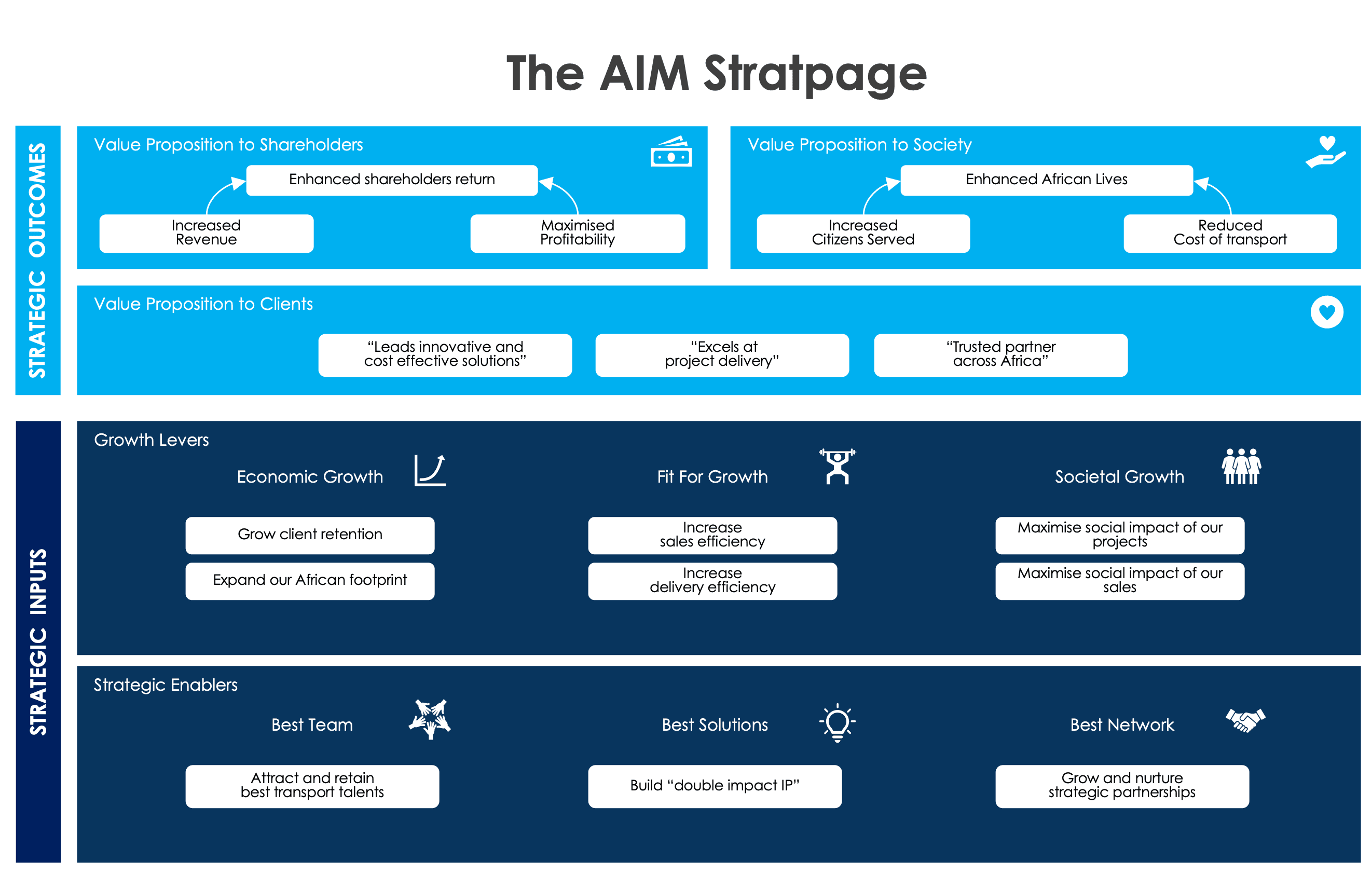
This is why strategic objectives need altitude. They must rise above the noise of daily execution and the pressure of immediate demands. They should not be written to satisfy this quarter’s panic, nor to reassure the leadership team that every pressing issue has been acknowledged. They should define the future shape of the organisation. They should express where the company is trying to go, what it is trying to become, and what capabilities, positions, and advantages it intends to build.
That is why the AIM stage requires leaders to stop. And think hard. Before moving any further, before selecting initiatives, before allocating resources, before building trackers and dashboards, they must ensure that the strategic objectives are genuinely strategic. If they get this wrong, everything that follows will be compromised. The wrong objectives will produce the wrong initiatives, the wrong priorities, and eventually the wrong results. A weak AIM Stratpage cannot be saved by brilliant execution. It will only allow the organisation to execute the wrong things more efficiently.
This is where many leadership teams struggle. Operational issues are visible, concrete, and immediate. Strategic objectives are harder. They require stepping back. They require abstraction without vagueness, ambition without fantasy, and clarity without operational detail. They require leaders to elevate the discussion beyond what the business is doing today and focus on what it must become tomorrow.
In practice, this means excluding from the AIM Stratpage the large blocks of operational management that naturally occupy executive attention. Revenue reporting, budget control, cost containment, service delivery, compliance, routine customer issues, system uptime, staffing gaps, and monthly firefighting all matter enormously. But unless they are connected to a genuine transformation of the business model, market position, value proposition, capability base, or long-term competitiveness, they should remain in the domain of operational management. They belong in the engine room, not in the strategic cockpit.
A strategy document should never become a dumping ground for unresolved management concerns. That temptation is understandable. Executives carry real pressure, and it is often comforting to place urgent issues on the strategy page, as if doing so elevates them. It does not. It simply pollutes the strategy. The AIM Stratpage must remain a high-altitude document. It must be selective, disciplined, and future-oriented.
A good way to think about it is this: operational objectives help the business perform. Strategic objectives help the business evolve, transform. Operational objectives protect and optimise the current model. Strategic objectives challenge, reshape, and extend it. Operational objectives keep the machine running. Strategic objectives define what the machine must become.
This does not mean strategy should ignore operational reality. Quite the opposite. Strong strategy is grounded in the realities of the current business. But it must not be imprisoned by them. Strategy should emerge from reality, not be reduced to it.
So stop here and pressure-test your objectives. Read each one carefully and ask yourself: is this truly shaping the future of the business, or is it simply managing the present more neatly? Is it transformative, or merely important? Is it shaping tomorrow, or describing today? These are not semantic questions. They are strategic ones.
The AIM Stratpage only works when it escapes the ordinary. It must elevate the conversation, sharpen the ambition, and define the business of tomorrow. That is the standard. And that is why this step will make or break everything that follows.
If your AIM Stratpage reads like an executive committee agenda, it is not strategic enough. The AIM Stratpage is not there to manage today’s problems. It is there to build tomorrow’s advantage. Lastly, do not confuse importance with strategy. Many things are important. Very few are truly strategic.
Author: Anael Granoux | Strategy Advisor, Lecturer, Speaker