
Initiative Rule 1: Obsess over impact.
If an initiative does not move the strategic needle, kill it!
Too many organisations confuse busyness with impact. They launch projects, attend progress meetings, create long reports and pride themselves on working very hard, while creating very little strategic movement.
The problem is not a lack of effort. In most organisations, people are already busy. Very busy. The problem is that too much of that energy is absorbed by initiatives that are operational, urgent, politically visible or simply familiar. But not truly strategic.
This is where the ACT Stratpage begins. Start by asking one brutal question: will this initiative / action genuinely move the needle on our strategic objectives? If the answer is no, it does not belong in your strategy execution agenda.
This sounds obvious, but it is rarely practised with enough discipline. Many organisations build initiative portfolios by collecting everything that is already happening. Every project wants to be called "strategic". Every department wants its programme to appear on the roadmap. Every leader wants their priorities to be visible. The result is often a crowded list of activities that looks impressive, but does not create focus. A powerful strategy execution roadmap should not be a catalogue of everything the organisation is doing. It should be a clear (and often very hard) selection of the handful actions that will make the biggest strategic impact. This is why strategic impact must be the first filter.
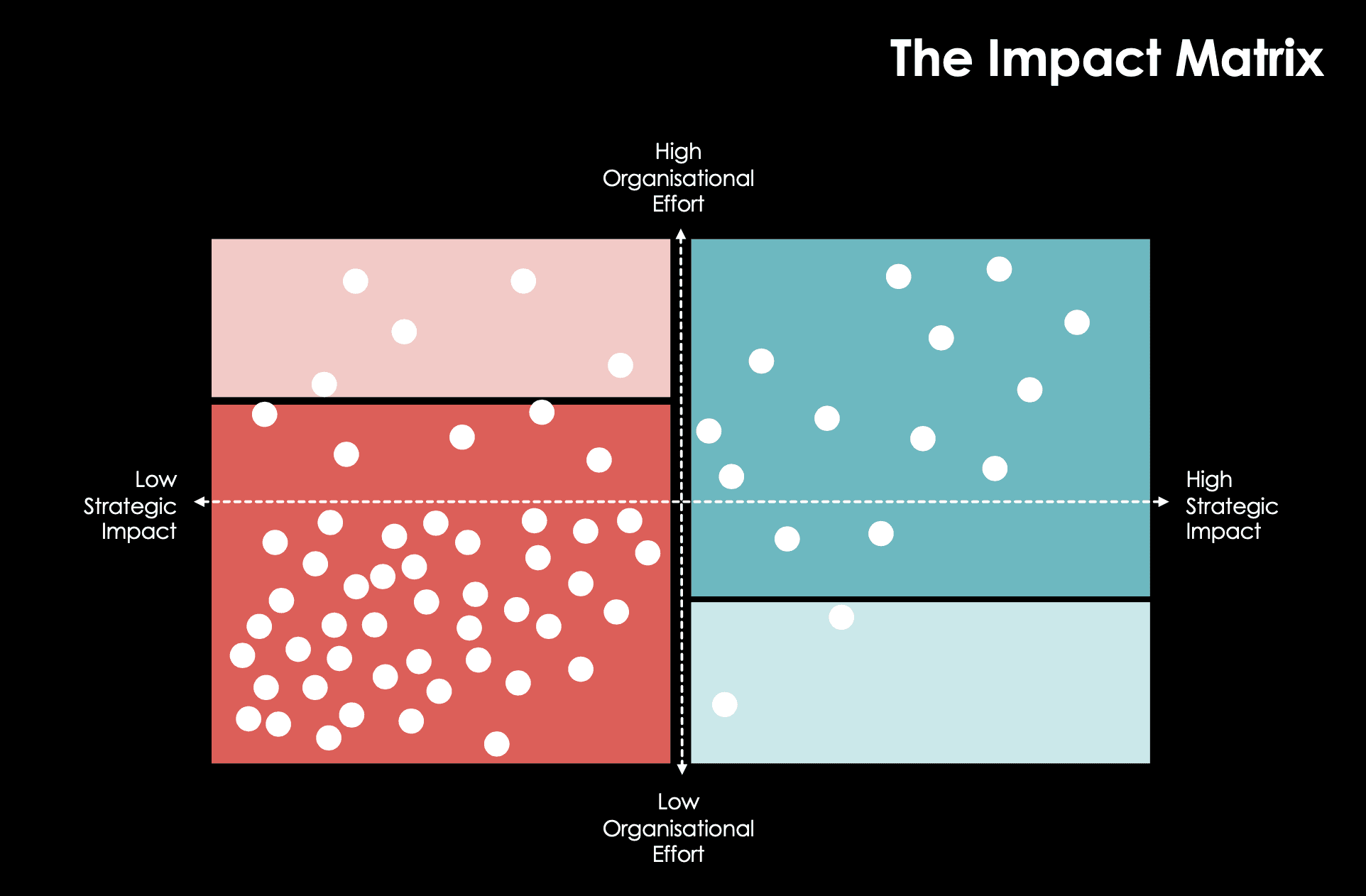
Strategic Impact Matrix:
A useful way to apply this filter is to build the Strategic Impact Matrix. Start by listing your current and planned actions, projects, campaigns and programmes (everything that keeps you and your team busy). Then assess each initiative against two simple dimensions:
The first is strategic impact: How strongly will this initiative contribute to the strategic objectives on your AIM Stratpage?
The second is organisational complexity: How difficult will it be to execute in terms of time, budget, people, leadership effort, cross-functional collaboration and change required?
This exercise creates a powerful conversation. It forces leaders to separate operational noise from strategic action. It highlights initiatives that may be useful, but not transformational. It reveals projects that absorb huge amounts of energy without creating meaningful value. It also brings attention to the few initiatives that are perhaps harder to execute, but essential to deliver real strategic results.
Four types of initiatives will stand out:
Some initiatives will be high impact and relatively easy to implement. These are the “no brainers” that should be accelerated quickly. Spoiler: you won't find a lot.
On the other side some initiatives will clearly be low strategic impact and highly complex. These are the dangerous ones, the "no ways". They create effort without movement. They should be stopped immediately.
Some initiatives will be high impact but (relatively, or very) complex. They are the 20% of action that drive 80% of the impact. They should be your "strategic obsession"! They require serious attention, resources and leadership commitment, but they are the ones most likely to shift the organisation towards its ambition.
Some initiatives will be, on the contrary, low impact and low complexity. They are easy or easier, employees know them, maybe like them. It's the comfort zone. But they are not part of the impact zone (the right side of the graph). Not only they are strategically irrelevant, they are also a strategic distraction, because all the effort, money, and resources they attract represents less effort, money, and resources for the real strategic initiatives. They are your strategic enemy!
Henry David Thoreau said it well: “It is not enough to be busy. So are the ants. The question is, what are we busy about?” That question should sit at the heart of every strategy execution conversation. Are we busy protecting the past, or building the future? Are we busy responding to noise, or delivering the strategy? Are we busy producing busyness, or driving real business impact?
In strategy execution, effort is not the goal. Impact is.
Stop the "busy being busy". Obsess over impact.
Author: Anael Granoux | Strategy Advisor, Lecturer, Speaker