
Many organisations end up with an extensive strategy. They produce lengthy documents that attempt to cover every possible goal, aspiration, risk, impact, theme and assumption. While this approach is well-intentioned, and often the result of thorough analysis, it frequently leads to a familiar outcome: the dreaded 500-page strategy document. You need to drastically summarise all this into a digestible, clear and appealing elixir.
The first school of thought tries to present a “clear” strategic direction that resembles a thick and dense collection of objectives, buzzwords, and loosely connected ideas. Some objectives overlap, others contradict each other, and many are expressed in vague or fashionable terminology. Despite the effort invested, the result often lacks clarity. Instead of offering clarity about what we are trying to achieve, it creates confusion. Everybody is lost.
At the opposite end of the spectrum, some leaders react to this complexity by pushing for extreme simplification. Strategy is reduced to a single word or a broad ambition such as “more”, “growth” or “transformation.” While appealing in its simplicity, this approach quickly reveals its limits. Without specificity, such statements provide little guidance. They fail to indicate what should be prioritised, what should change, or how success will be achieved. Everybody which to have a bit “more”.
The challenge, therefore, is not to choose between accuracy and simplicity, but to reconcile the two. Strategy must be both well-structured and crystal-clear. It must capture the richness of the thinking while remaining understandable and articulated.
This is precisely the role of the AIM Stratpage. The logic is simple: strategy should be like an espresso: distilled to its essence, concentrated in its impact. This does not mean reducing strategy to a slogan. It means distilling it. The AIM Stratpage captures, in one page, the essence of the strategic direction. The coffee analogy is deliberate. A well-brewed espresso is neither diluted nor overwhelming. Too long, and it loses its intensity like an americano. Too short, and it becomes difficult to appreciate and bitter like a ristretto. The same applies to strategy. If it expands beyond a single page, it risks becoming diluted and losing focus. If it is overly compressed into vague statements, it becomes unusable.
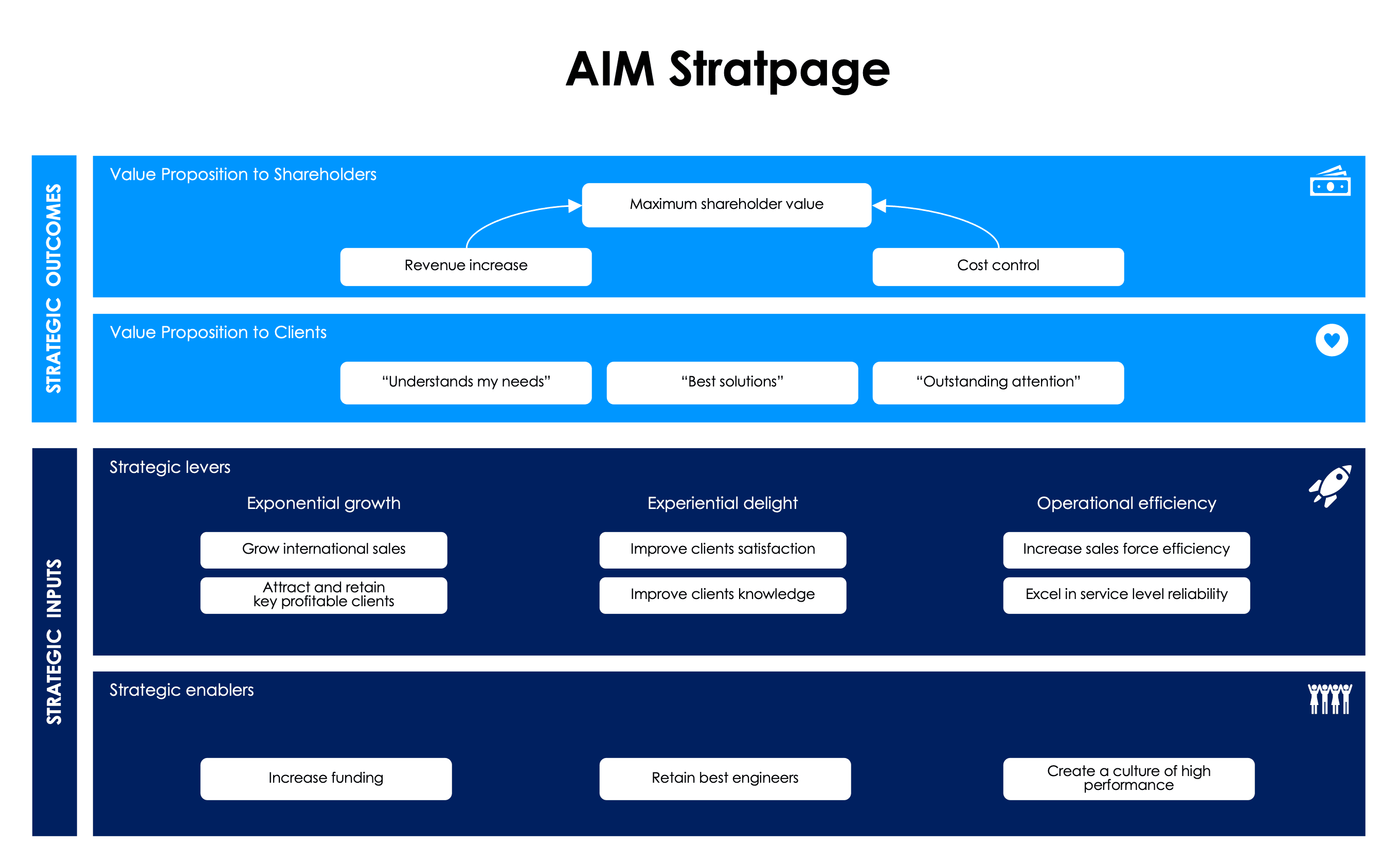
Contrary to what one might expect, producing a one-page strategy is not easier than producing a long document. As Mark Twain famously observed “I’ve written you a long letter because I didn’t have time to write you a short one.” Writing something short takes much more time than writing something long. The same is true for strategy. The clear and structured AIM Stratpage is the result of effort and time, not of simplification and shortcuts.
This discipline allows focus. By limiting the space available, the AIM Stratpage forces leaders to identify the few strategic objectives that truly matter. It encourages a shift away from exhaustive lists toward a clear prioritisation of what will drive the organisation forward. In doing so, it separates strategy from operations and removes the noise of day-to-day activities, keeping attention on transformation.
Perhaps most importantly, it forces leaders to make trade-offs, it requires making tough choices, resolving ambiguities, and ignoring urgent matters, important issues, day-to-day thinking, operational challenges: it’s a ruthless elimination of all the non-essentials. Every strategic objective included on the page occupies valuable space. Including one means excluding another. It reinforces a fundamental principle of strategy: choosing what not to do is as important as choosing what to do. By making these choices explicit, the AIM Stratpage helps organisations move from intention to commitment.
It also facilitates alignment. Reaching consensus on a complex, multi-page document is difficult, if not impossible. Different stakeholders interpret it differently and emphasise different elements. A single page, however, creates a shared reference point. It becomes possible to challenge, refine, and ultimately agree on a common direction. The AIM Stratpage turns strategy into something that can be collectively understood and owned.
Once completed, the AIM Stratpage becomes the anchor of the strategy execution system. It is not just a document. It is a way of thinking. Like a well-prepared espresso, it captures the essence of something much larger, in a form that is both concentrated and effective.
Author: Anael Granoux | Strategy Advisor, Lecturer, Speaker